
Your data may be great research, but is it “new knowledge”?

I used to love travel photography. It combined two of my passions: travel and photography. Until the day someone said, “One man’s ‘travel’ photography is another man’s ‘everyday life’ photography.”
Which means that your travel photography is only interesting because it’s new to you. For the locals whose environment you’ve photographed – you’re just taking photos of their back yard and their everyday, mundane lives. Something similar happens in academic research fieldwork.
With great flourish, a researcher dramatically enters “the field” – which may be a foreign country, or a community they’re investigating, or a even simply a literary domain. They gallantly conduct data collection: interviews of victims, surveys, or close reading of texts. Our hero exits “the field”, comes home, publishes their data, everyone congratulates their deep and novel insights, they win top prize in the travel photography category. But while this data may be high-quality research, is it “new knowledge”?
I ask the question because following Michael Polanyi,1 research sometimes merely surfaces tacit knowledge or lived experiences which already exist in “the field”, rather than creating new knowledge. The data which you are calling “new knowledge” is actually already known to the people who you interviewed, or who originally produced it.
It could be argued that the interpretation, analysis and theorisation of tacit knowledge creates new knowledge, and I accept there is value in such research. However, the counter-argument is that the owners of the tacit knowledge probably already had deeper insights than yours as an outsider, but we’ve simply never heard their voices. This concern becomes even more acute when we look at it through the lens of decolonial theory.
From that perspective, I worry that sometimes, what we think of as “new knowledge” is only new for the researcher. And it only became knowledge when a Western institution deemed it worthy of attention. This is precisely the epistemic injustice that decolonial theory critiques.
Of course, not every discipline or research question is oriented toward generating brand-new data or numerical findings, and not every project should be. Scholarship advances through many complementary modes. I value qualitative research deeply. In my own work, though, I tend to gravitate towards quantitative methods because they lend themselves more readily to generating “new knowledge,” which according to Boyer’s Model of Scholarship (1990), is a higher epistemological objective in research. And getting your hands on “new knowledge” can be intoxicating.
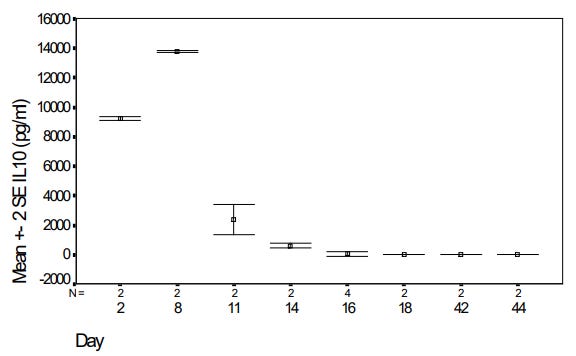
I remember the excitement on my supervisor Professor Nick Sheron‘s face in 1997 when my laboratory data showed interleukin 10 (IL-10) production from liver cells. He remarked, “No-one in the entire history of mankind has ever known what we have just found out today for the first time.” I must admit, the profundity of that moment was lost on me – as a 22-year-old undergraduate, I was just glad my IL-10 assays were finally working! But his perspective has remained with me, and this ethos permeates through my current research.
My research is investigating the linguistics of texts using a metric and analytical tool, both of which I invented specifically for this purpose! Like my IL-10 data in the graph above, the numbers coming out of this research have never been seen before by anyone. This is as new as “new knowledge” gets!
“New knowledge” sits at the top of the hierarchy of academic scholarship. It is acknowledged – although rarely discussed – that research which produces knowledge that previously did not exist is distinct from research that surfaces tacit knowledge which already exists. Epistemologically, these represent distinct levels of contribution: creation versus elicitation. While both have value, we should try to aim for creation, because its newness is more likely to advance the boundaries of knowledge itself.
And that’s A Deeper Thought.
Update: Dr.Himanshu Gul Mirani‘s excellent reply and follow-up to this post.
Michael Polanyi, The Tacit Dimension. University of Chicago Press, 2009. ISBN 9780226672984.
The post Your data may be great research, but is it “new knowledge”? appeared first on A Deeper Thought.