
“A Roman, a Hellene, and an Abbasid walk into a café…”

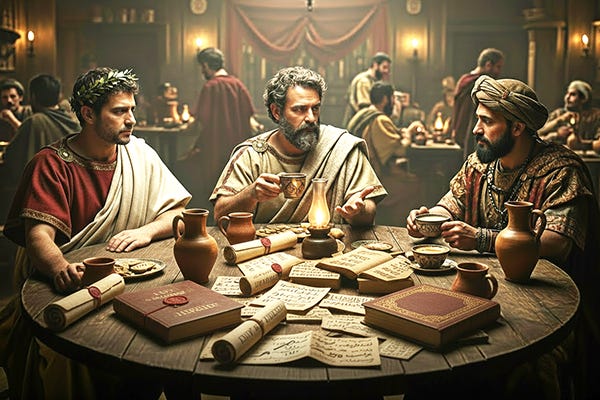
Put Latin, Ancient Greek and Arabic words into a bag. Jumble them all up. Then ask AI to make sense of them all. What could possibly go wrong?
Well… turns out that it can break your AI models completely!
So, today we removed all the Latin and Ancient Greek synonyms for Arabic rhetorical devices in the Encyclopedia of Arabic Rhetoric, a landmark in the development of the Encyclopedia.
Background
When the Encyclopedia was created in September 2022, the very idea of a comprehensive taxonomy of Arabic rhetorical devices in English was new.
There was an almost existential desire to anchor our English descriptions of Arabic rhetorical devices – along with their names – in existing Latin and Greek terminology. This would make the taxonomy more acceptable and understandable to an English-speaking audience.
That’s why a device such as A-12: Foregrounding and Backgrounding would have a very prominent statement such as “Also known as Anastrophe”.
Or CH-9: Diminishing Expression would be listed as “Also known as Abbaser, Humiliatio, Depreciation.”

The Problem
As the Encyclopedia became more established and mature, this dual-naming strategy started to cause problems.
Firstly, it was always recognised that identifying an Arabic rhetorical device such as B-4: Allegory as being synonymous with “synecdoche” was epistemologically incorrect. The Encyclopedia‘s definition of B-4: Allegory – which reflects the Arabic term al-majāz – is much wider than “synecdoche”. There is only partial overlap between B-4: Allegory and synecdoche, but synecdoche was the nearest term we could find.
Secondly, the rhetorical devices in the Encyclopedia were published as the Arabic Rhetorical Device Taxonomy in November 2025, which was subsequently the basis for the Arabic Rhetorical Device Identifier, a custom GPT and AI system prompt package to assist in identifying Arabic rhetorical devices. All the so-called synonyms in Latin and Greek were incorporated into the AI, along with Arabic device definitions.
In designing the custom AI instructions, we worked hard to constrain the AI to using our Arabic rhetorical device definitions exclusively. Yet at the same time, we were inadvertently telling the AI – through the back-door of “synonyms” – to draw on non-Arabic theoretical frameworks as well! Consequently, the AI would drift away from our Arabic definitions, and incorporate its own training on non-Arabic terminology into its reasoning.
What was originally intended to help human users, now became a hindrance for AI. This tolerance of conceptual fuzziness – an acceptable compromise in 2022 when the Encyclopedia was launched – would result in a diagnostic imprecision when fed into the AI in 2025.
Thirdly, there was a gradual realisation that archaic terms such as “Abbaser”, “Humiliatio” and “Hypallage” were hardly in common use. Therefore, trying to anchor the Encyclopedia in these terms was ultimately futile. The cost was confusion and a sense of foreignness for Encyclopedia users.
The Solution
In recognition of the increasing maturity and establishment of the Encyclopedia of Arabic Rhetoric – which now exists beyond the website in the form of the Balagha-ID app, and the Arabic Rhetorical Device Identifier – we have now removed all Latin and Greek synonyms for Arabic rhetorical devices from the Encyclopedia.
This change will shortly ripple through the wider BALAGHA Score infrastructure, of which the Encyclopedia is an integral component.
This marks a confident step forward in presenting Arabic rhetoric on its own terms, free from the constraints of imperfect equivalencies, and anchored firmly in its own rich intellectual tradition.
What are your thoughts on this evolution?
The post “A Roman, a Hellene, and an Abbasid walk into a café…” appeared first on A Deeper Thought.