
Is Trump Serious???
When you read another one of Donald Trump's outlandish tweets, how can you tell how serious he is?

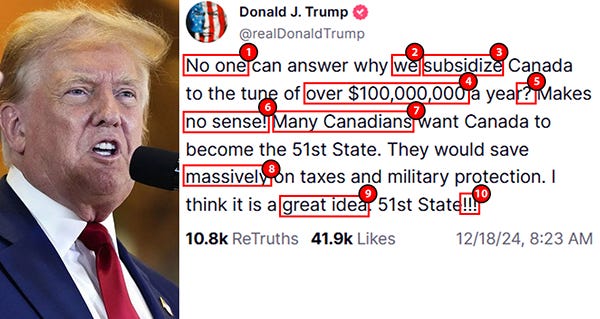
Donald Trump is a prolific tweeter. There’s one particular tweet that I talk about whenever I do a presentation about my research. It is from 18th December 2024, after he won his second US presidential election, but before his inauguration. In this tweet, he floats the idea that Canada should be a state of the USA.
But is Trump serious? Does he really expect Canada to become a US state? Or is the tweet simply a show of his political strength? Is he just trying to boost his ratings? Or to strongarm Canada into a tariff deal more favourable to the US? How far will he go with this – will he annexe Canada by force? Are the tweet’s shockwaves a harbinger of the next 4 years? All valid – and uneasy – questions.
Opinions are wildly split on the answers. His supporters see it as a credible plan; his opponents feel his suggestion is too unrealistic to take seriously. In between, the bewildered majority don’t know what to think. Perhaps the provocative tweet was designed to obscure the President-elect’s real intentions for his presidency?
A different approach
But wait, let’s analyse the tweet rationally, for a moment. To me, it’s immediately obvious that the tweet is dripping in rhetoric.
The whole point of rhetoric is to create an effect in the reader – whether it’s anger, frustration, surprise, agreement, fear, admiration, or even if only to make the argument more convincing.
Here are 10 rhetorical devices which are immediately obvious:
It’s hyperbole or feigned ignorance to say that no-one can provide an answer
The original sentence is “the US subsidizes Canada” but use of the pronoun “we” to represent the US builds a shared identity with the reader, against the common adversary, Canada.
The subsidy is actually a trade deficit, not a subsidy at all. Trump has allegorically used the related word “subsidy” which has a connotation of unfair support.
By saying “over $100,000,000” Trump is being deliberately vague, highlighting that the precise amount is not relevant, and it is sufficient for us to know that it’s a large amount.
This rhetorical question is aimed to provoke outrage.
This rhetorical astonishment supports the rhetorical question in provoking outrage.
Another example of deliberate vagueness, where Trump does not state how many Canadians, or what percent of Canadians, or which Canadians he is referring to.
This one’s interesting – rather than giving the reader a dollar amount to evaluate, Trump is deliberately vague, inviting the reader to trust his judgement of “massively”.
Same strategy as #8 – presenting his own conclusion as truth – this time via hyperbole.
Repetition of the exclamation marks cause intensification of the excitement around the idea.
The deeper question
Now, here’s the really interesting issue. Some of Trump’s tweets have more rhetoric, some have less. So, can we infer anything about Trump’s mindset from the amount of rhetoric in a tweet?
I mean, could it be that a highly rhetorical tweet is about grandstanding, posturing, threatening, distracting, or floating a new idea? Whereas a less rhetorical tweet is more “business”: that he is more likely to act on it? Or is it the other way round – the more rhetorical, the more dangerous?
Rhetoric in English is very mature, drawing from roots in Ancient Greek and Latin rhetorical theory from over two millennia. However, I have identified a major theoretical gap – not only in English rhetoric, but in rhetoric in any language: there is no way to quantify how much rhetoric a text contains. We are unable to put a number on the rhetoricity of Trump’s tweets.
No-one can tell me whether Trump’s tweet about Canada contains more, less, or the same amount of rhetoric as his others. We are unable to work out any analytical patterns of his rhetoricity. We are unable to make any predictions based on his rhetoricity. This is despite all the rhetorical techniques he uses staring back at us defiantly in plain sight.
Rhetorical Density
Situations such as this are exactly the reason why I invented the metric which I named “Rhetorical Density”, to address this theoretical gap. It builds on existing metrics such as lexical density, which use what is generally known in quantitative linguistics as relative frequency analysis.
Rhetorical density is simply a quantitative measure of how many rhetorical devices are present in any text, in any language. In the example above, I found 10 rhetorical devices. To take into account the length of the text, we divide by the number of words, in this case 46. To make the resulting number easier to work with, we multiply by 100. This tweet therefore has a rhetorical density of 21.739 rhetorical devices per 100 words.
There is, of course, some additional nuance. Firstly, we need a language-specific list of standardised rhetorical device definitions. Secondly, while its easy to count the number of words in languages such as English, it is more difficult in languages such as Arabic, Spanish or Turkish where a single word may incorporate multiple meaningful components. So we need standardised rules for counting words in these languages.
As an illustration, I can tell you about my own particular interest in the measurement of rhetorical density in Arabic. As part of my PhD research, I have created standardised definitions of Arabic rhetorical devices, which are available at the Encyclopedia of Arabic Rhetoric. For academic use, these have been distilled into the citable Arabic Rhetorical Device Taxonomy. I have also created a set of detailed rules for breaking up and counting compound Arabic words.
All these resources are open source, and freely available for everyone to use. I will be using them in my research to compare the rhetoricity of different genres of Arabic literature ranging from news reports, to poetry, to the Quran.
What will you do with Rhetorical Density?
Rhetorical Density is not about Trump, or social media, or even English. Every speech, every headline, every poem carries patterns of persuasion beneath the surface. Measuring rhetorical density is about learning to see the hidden codes that underpin persuasive language more clearly. If we can identify and enumerate them, we can begin to understand the persuasive strategy with far greater precision.
So, over to you… next time you read a tweet, a news report, or even a sacred text, ask yourself: how rhetorically dense is this text? And what might the rhetorical density reveal? Remember, it’s not only about written texts – the same principles apply to speech as well. If this idea intrigues you, explore the resources I’ve linked to above, test the metric yourself, and become a rhetorical analyst!
The post Is Trump Serious??? appeared first on A Deeper Thought.